Saturday, April 18, 2020

What is preposition?

Prepositions

A preposition is a word (often a short word) that expresses the relationship between two other nearby words. In the examples below, each preposition (highlighted) shows us the relationship between the word book and the word wizard.
  • The book about the wizard
  • The book by the wizard
  • The book near the wizard
  • The book behind the wizard
  • The book under the wizard

List of Common Prepositions

Here is a list of common prepositions:

above, about, across, against, along, among, around, at, before, behind, below, beneath, beside, between, beyond, by, down, during, except, for, from, in, inside, into, like, near, of, off, on, since, to, toward, through, under, until, up, upon, with, within

Click on Two Prepositions

bright

Wrong

adjective

whispering

Wrong

adjective

urgently

Wrong

adverb

opportunity

Wrong

abstract noun

straight

Wrong

adjective

delightfully

Wrong

adverb

old

Wrong

adjective

in

Correct!

preposition

with

Correct!

preposition

The Role of a Preposition

A preposition precedes a noun (or a pronoun) to show the noun's (or the pronoun's) relationship to another word in the sentence. In each example above, the preposition preceded the noun the wizard to show that noun's relationship with the noun The book.

Here are some more examples:
  • It is a container for butter.
  • (The preposition for shows the relationship between butter and container.)
  • The eagle soared above the clouds.
  • (The preposition above shows the relationship between eagle and clouds.)
  • He is the President of the United States.
  • (The preposition of shows the relationship between the United States and President.)

A Good Way to Think about Prepositions

When you're first learning about prepositions, it is useful to think about prepositions as anywhere a mouse could go.

prepositions
This works because lots of prepositions show the relationship between two words by expressing their location relative to each other (e.g., on, near, behind, under, inside).

Real-Life Examples of Prepositions

  • I cook with wine. Sometimes, I even add it to food. (Actor W C Fields)
  • (With shows the relationship between wine and cook. To shows the relationship between food and add it.)
  • Behind every great man is a woman rolling her eyes. (Actor Jim Carrey)
  • (Behind shows the relationship between every great man and is. The term every great man is a noun phrase. Note that a preposition can sit before a noun, a noun phrase, a noun clause, or a pronoun.)
  • The difference between stupidity and genius is that genius has its limits. (Physicist Albert Einstein)
  • (Between shows the relationship between stupidity and genius.)
  • If you haven't got anything nice to say about anybody, come sit next to me. (Writer Alice Roosevelt Longworth)
  • (About shows the relationship between anybody and to say. Next to shows the relationship between me and sit. Note that a preposition can be more than one word. Other common multi-word prepositions are close to, ahead of, in front of, and according to.)

Origin of the Word Preposition

The word preposition comes from the idea of being positioned before.

Object of a Preposition

The word (or words) that follows a preposition is called the object of a preposition. If there is a preposition, there will always be an object of the preposition. A preposition cannot exist by itself.
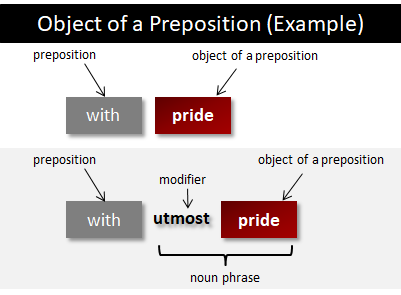
object of a preposition
Read more about the object of a preposition.

Prepositional Phrase

A prepositional phrase is made up of a preposition and the object of the preposition (including any modifiers). Prepositional phrases are very common. They function as either adjectives or adverbs. For example (prepositional phrases highlighted):
  • It is a message from Mark.
  • (Here, the prepositional phrase from Mark is functioning like an adjective because it is describing message.)
  • Mark is trapped on the island.
  • (Here, the prepositional phrase on the island is functioning like an adverb because it is modifying the verb is trapped.)
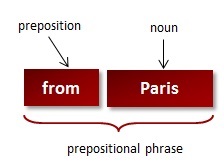
prepositional phrase

Why Should I Care about Prepositions?

There are four common issues involving prepositions:

(Issue 1) Try to avoid ending a sentence in a preposition.

Lots of people think it is incorrect to end a sentence in a preposition because, as we've just covered, a preposition is supposed to sit before a noun. (It is, after all, how preposition gets its name.) Therefore, if the preposition is the last word in the sentence, it can't sit before anything. So, there's some logic to this ruling, which many people follow. However, this issue is far more complicated than many realise, and the best way to summarize it is by saying that, in the overwhelming majority of cases, it's perfectly acceptable - from a grammatical perspective - to end a sentence in a "preposition." (I'll explain the quotation marks later.)

Here's the rub. Even though you'd very likely be correct by ending your sentence with a "preposition," you should be mindful that a fair few of your readers will think it's a grammar mistake or sloppy writing. As we still haven't trained ourselves to strikethrough this so-called ruling, we can't ignore it. I like to think of "avoiding a preposition at the end of a sentence" as a game rather than a ruling. Let's look at an example:
  • It is a scenario I have not thought of.
  • (This is natural sounding, but it ends in a preposition.)
Let's play the game. Let's restructure our sentence:
  • It is a scenario of which I have not thought.
  • (This sounds awful. It's unnatural and contrived. On the plus side, our preposition now sits before the pronoun which, and that fits the rule for siting a preposition.)
But, it sounds terrible, so let's keep playing. Let's reword our sentence:
  • It is a scenario I have not considered.
  • (Yes! This sounds natural, and it does not end in a preposition. This keeps everyone happy...except those people who think we shouldn't pander to those who still think you can't end a sentence in a preposition.)
So, for now, I'm advising you become a panderer to this non-ruling. I must say this though. If restructuring your sentence makes it sound contrived and you can't reword it, then just let the preposition at the end ride. If you're questioned on it, fight like a dog because you'll be in the right.

So, why was preposition in quotation marks earlier in this section? Well, quite often, your sentence will end in something that looks like a preposition but isn't. Be mindful that it could be part of a phrasal verb, i.e., a verb made up of a verb and another word (either a preposition or a particle), e.g., fill in, stick to, catch up, catch out. Quite often, these words must be next to each other, and that's often a factor in your sentence structure.

(Issue 2) Don't use the wrong case after a preposition.

The word or words that follow a preposition are called the object of a preposition. The object of a preposition is always in the objective case. This just means that words like I, she, we, and they change to me, her, us, and them when they follow a preposition (e.g., about me, with her, for us, against them). This is a pretty simple concept for a native English speaker, but it still catches some people out.
  • It is present from my wife and I. 
  • (This is wrong because I cannot be the object of the preposition from.)
  • It is present from me and my wife. 
  • Between you and I 
  • (This is wrong because I cannot be the object of the preposition between.)
  • Between you and me 
Ironically, many people use terms like "from my wife and I" and "between you and I" with a highbrow tone, believing them to be grammatically pure. They're not grammatically pure. They're wrong.

Another one that catches people out is using who after a preposition. Who becomes whom in the objective case. In other words, who is to whom as he is to him or they is to them. The bottom line is who cannot be the object of a preposition. You need whom.)
  • You went with who? 
  • You went with whom? 
  • (Write whom after a preposition.)

(Issue 3) Don't confuse prepositions with other words.

Writers sometimes confuse prepositions with other words. Here are the most common issues ordered by how frequently they are seen:
  • Writing the adverb too (which means overly or as well) instead of the preposition to (which has several meanings including towards and for).
Read more about too and to.
  • Writing the preposition of instead of have when writing could've, should've, or would've in full.
Read more about could've, would've, and should've.
  • Writing the noun dependant (a person, usually a child or spouse) in the multi-word preposition dependent on (which means reliant on).
Read more about dependent and dependant.
  • Writing the preposition past (beyond) instead of passed (past tense of to pass).
Read more about past and passed.
  • Writing the preposition between (usually used with two distinct points) instead of the preposition among (in the middle of a group).
Read more about between and among.

(Issue 4) Keep your writing succinct.

Some phrasal verbs (i.e., multi-word verbs) have prepositions that do not add anything. When you encounter one of these, delete the prepositions to improve succinctness.
  • I cannot face up to the consequences.
  • (This is correct, but it's not succinct.)
  • I cannot face the consequences.
  • (This is sharper. The prepositions were a waste of ink.)

What is adverb?

Adverbs

At school, you may have been told that adverbs end -ly and modify verbs. That is all true, but adverbs do far more than that description suggests.

Adverbs can also modify adjectives and other adverbs. Although many adverbs end -ly, lots do not (e.g., fast, never, well, very, most, least, more, less, now, far, and there).

adverbs grammar

Adverbs Modifying Verbs

An adverb that modifies a verb usually tells you when, where, how, in what manner, or to what extent the action is performed. (NB: The ones that end ly are usually the ones that tell us how the action is performed, e.g., quickly, slowly, carefully, quietly.)

Here are some examples of adverbs modifying verbs:
  • Anita placed the vase carefully on the shelf.
  • (The word carefully is an adverb. It shows how the vase was placed.)
  • Tara walks gracefully.
  • (The word gracefully is an adverb. It modifies the verb to walk.)
  • He runs fast.
  • (The word fast is an adverb. It modifies the verb to run.)
  • You can set your watch by him. He always leaves at 5 o'clock.
  • (The word always is an adverb. It modifies the verb to leave.)
  • The dinner guests arrived early.
  • (Here, early modifies to arrive.)
  • She sometimes helps us.
  • (Here, sometimes modifies to help.)
  • Will you come quietly, or do I have to use earplugs? (Comedian Spike Milligan)
  • (Here, quietly modifies to come.)
  • I am the only person in the world I should like to know thoroughly. (Oscar Wilde)
  • (Here, thoroughly modifies to know.)

Adverbs Modifying Adjectives

If you examine the word adverb, you could be forgiven for thinking adverbs only modify verbs (i.e., "add" to "verbs"), but adverbs can also modify adjectives and other adverbs. Here are some examples of adverbs modifying adjectives:
  • The horridly grotesque gargoyle was undamaged by the debris.
  • (The adverb horridly modifies the adjective grotesque.)

  • Peter had an extremely ashen face.
  • (The adverb extremely modifies the adjective ashen.)

  • Badly trained dogs that fail the test will become pets.
  • (The adverb badly modifies the adjective trained.)
    (Note: The adjective trained is an adjective formed from the verb to train. It is called a participle.)

  • She wore a beautifully designed dress.
  • (The adverb beautifully modifies the adjective designed.)

Adverbs Modifying Adverbs

Here are some examples of adverbs modifying adverbs:
  • Peter Jackson finished his assignment remarkably quickly.
  • (The adverb quickly modifies the verb to finish. The adverb remarkably modifies the adverb quickly.)
  • We're showing kids a world that is very scantily populated with women and female characters. They should see female characters taking up half the planet, which we do. (Actress Geena Davis)
  • (The adverb scantily modifies the adjective populated. The adverb very modifies the adverb scantily.)

More about Adverbs

When an adverb modifies a verb, it can often be categorized as one of the following:
TypeExamples
Adverb of Manner
(how)
An adverb of manner tells us how an action occurs.
  • The lion crawled stealthily.
  • Will you come quietly, or do I have to use earplugs? (Comedian Spike Milligan)
(NB: Lots of adverbs of manner end -ly.)
Adverb of Time
(when and how often)
An adverb of time tells us when an action occurs or how often.
  • I tell him daily.
  • What you plant now, you will harvest later. (Author Og Mandino)
(NB: Adverbs of time that tell us how often something occurs (e.g., always, often, sometimes) are also known as "adverbs of frequency.")
Adverb of Place
(where)
An adverb of place tells us where an action occurs.
  • I did not put it there.
  • Poetry surrounds us everywhere, but putting it on paper is, alas, not so easy as looking at it. (Artist Vincent Van Gogh)
Adverb of Degree
(aka Adverb of Comparison)
(how much)
An adverb of degree tells us to what degree an action occurs.
  • He works smarter.
  • Doubters make me work harder to prove them wrong. (Businessman Derek Jeter)
These are the main four categories. We'll discuss the others in a bit. Don't forget that adverbs can also modify adjectives and other adverbs.
  • To expect the unexpected shows a thoroughly modern intellect. (Playwright Oscar Wilde)
  • (The adverb thoroughly modifies the adjective modern.)
  • If a thing is worth doing, it is worth doing very slowly. (Burlesque entertainer Gypsy Rose Lee)
  • (The adverb very modifies the adverb slowly.)

Even More about Adverbs

In all the examples above, the adverbs have been single words, but multi-word adverbs are common too. Adverbs commonly come as phrases (i.e., two or more words) or clauses (i.e., two or more words containing a subject and a verb). Below are some examples of multi-word adverbs. This list also includes adverbs of condition, adverbs of concession, and adverbs of reason.
TypeExamples
Adverb of MannerAn adverb of manner often starts with a preposition (e.g., in, with) or one of the following: as, like, or the way. (These are called subordinating conjunctions.)
  • Money speaks, but it speaks with a male voice. (Author Andrea Dworkin)
  • (This is called a prepositional phrase. It's also an adverbial phase.)
  • People who say they sleep like a baby does usually don't have one. (Psychologist Leo J. Burke)
Adverb of TimeAn adverb of time often starts with a preposition or one of the following subordinating conjunctions: after, as, as long as, as soon as, before, no sooner than, since, until, when, or while.
  • A company like Gucci can lose millions in a second. (Gucci CEO Marco Bizzarri)
  • After the game has finished, the king and pawn go into the same box. (Italian proverb)
Adverb of PlaceAn adverb of place often starts with a preposition or one of the following subordinating conjunctions: anywhere, everywhere, where, or wherever.
  • Opera is when a guy gets stabbed in the back and, instead of bleeding, he sings. (Ed Gardner)
  • Some cause happiness wherever they go; others whenever they go. (Playwright Oscar Wilde)
Adverb of Degree (aka Adverb of Comparison)An adverb of degree often starts with one of the following subordinating conjunctions: than, as...as, so...as, or the...the.
  • Nothing is so contagious as enthusiasm. (Poet Samuel Taylor Coleridge)
  • Be what you are. This is the first step toward becoming better than you are. (Writer Julius Charles Hare)
Read more about comparatives of adverbs (like more cleverly).
Adverbs of ConditionAn adverb of condition tells us the condition needed before the main idea comes into effect. An adverb of condition often starts with if or unless.
  • If the facts don't fit the theory, change the facts. (Theoretical physicist Albert Einstein)
  • Age doesn't matter, unless you're a cheese. (Filmmaker Luis Bunuel)
Adverbs of ConcessionAn adverb of concession contrasts with the main idea. An adverb of concession often starts with a subordinating conjunction like though, although, even though, while, whereas, or even if.
  • Although golf was originally restricted to wealthy, overweight Protestants, today it's open to anybody who owns hideous clothing. (Comedian Dave Barry)
  • A loud voice cannot compete with a clear voice, even if it's a whisper. (Writer Barry Neil Kaufman)
  • Adverbs of ReasonAn adverb of reason gives a reason for the main idea. An adverb of reason usually starts with a subordinating conjunction like as, because, given, or since.
    • I don't have a bank account because I don't know my mother's maiden name. (Comedian Paula Poundstone)
    • Since we cannot change reality, let us change the eyes which see reality. (Greek author Nikos Kazantzakis)

    Why Should I Care about Adverbs?

    At school, you may have been told that an adverb is a word that ends -ly and tells us how a verb is performed. Yes, that does describe an adverb, but it doesn't describe all adverbs, as we've seen. Here are the six most common issues related to adverbs.

    (Issue 1) Use adverbs ending -ly sparingly.

    Professional writers (particularly fiction writers) don't like adverbs that end -ly. They consider them unnecessary clutter. If you were to attend a fiction-writing course, you would be taught to craft words that render -ly adverbs redundant. On that course, you would undoubtedly be shown this quote:
    • The road to hell is paved with adverbs. (Author Stephen King)
    As Stephen King advocates, if you choose the right verb or the right dialogue, you don't need an adverb. Compare these two examples:
    • Extremely annoyed, she stared menacingly at her rival.
    • (Critics on that course would trash this.)
    • Infuriated, she glared at her rival.
    • (This is far sharper.)
    Here are the three good reasons to kill a -ly adverb:

    (1) The adverb is a tautology (i.e., needless repetition of an idea).
    • She smiled happily.
    (2) The adverb is "spoon feeding" the reader.
    • She smiled disappointedly.
    • (By the time your readers reach this sentence, they should know from context that it's a disappointed smile. The trick is to show them, not literally tell them, that she's disappointed. It's far more engaging. Less is more.)
    Spoon-feeding with an adverb happens most commonly with verbs like said, stated, and shouted (known as verbs of attribution).
    • "Ow, pack that in," Rachel shrieked angrily.
    • (You can scrap the adverb if it's implicit from the dialogue or context.)
    (3) The adverb is only there because of a badly chosen verb.
    • Sitting dejectedly in its cage, the parrot looked utterly unhappy.
    • (This would cause a click-fest as those critics armed their red pens.)
    • Looking miserable, the parrot lay on the floor of its cage.
    • (This is sharper. Your readers will know that parrots don't ordinarily lie on the floor.)
    Avoiding adverbs is a self-imposed restraint that many writers follow. It's like a game. Upon completing their work, professional writers will often do a text search for "ly " (note the space) to find adverbs and to re-justify their use before submission. Remember though that if your adverb is part of the story, keep it.
    • Your son is surprisingly handsome.

    (Issue 2) Delete very and extremely.

    Professional writers hate adverbs such as extremely, really, and very (called intensifiers). For them, using an intensifier demonstrates a limited vocabulary. It's a fair point. If you choose the right words, you can avoid intensifiers.
    Don't write…Go for something like…
    very badatrocious
    extremely hungryravenous
    really oldancient
    incredibly tiredexhausted
    Many writers assert that intensifiers are so useless, you should delete them even if you can't find a more descriptive word.
    • Ireland is great for the spirit but very bad for the body. (Actor Hugh Dancy)
    • (The deletion kills a word but no meaning.)
    Writer Mark Twain shared this view:
    • Substitute "damn" every time you're inclined to write "very". Your editor will delete it, and the writing will be just as it should be.
    Here's a good tip. Press "CTRL H". Put "very" in the Find box. Put nothing in the Replace box. Click Replace All.

    (Issue 3) When an adverb modifies an adjective, don't join them with a hyphen.

    When an adverb modifies an adjective, don't join the two with a hyphen.
    • I don't sleep with happily married men. (Actress Britt Ekland) 
    • Ironically, he described himself as "a professionally-qualified grammarian". 
    • (Don't join the adverb and the adjective with a hyphen.)
    Remember that not all adverbs end -ly.
    • The beginning is the most-important part of the work.  (translation of Greek philosopher Plato)
    As covered next, this no-hyphen rule applies only to adverbs that are obviously adverbs (e.g., ones that end -ly).

    (Issue 4) When an adverb that could feasibly be an adjective modifies an adjective, use a hyphen.

    A few adverbs (e.g., well and fast) look like adjectives. To make it clear your adverb is not an adjective, you can link it to the adjective it's modifying with a hyphen. The hyphen says "these two words are one entity," making it clear they're not two adjectives.
    • She's a well-known dog. 
    • (The hyphen makes it clear that the dog is famous (i.e., well-known) as opposed to well (i.e., healthy) and known (i.e., familiar).)
    • He sold me six fast-growing carp.
    • (The hyphen makes it clear the carp are ones that grow quickly and not growing ones that can swim quickly.)
    This issue crops up occasionally with well, and well is almost never used as an adjective (meaning healthy) in a chain of other adjectives. So, in real life, there's almost never any ambiguity caused by these adjectivey-looking adverbs. Therefore, the following rule will cover 99% of situations: use a hyphen with well when it precedes an adjective.
    • It's a well-known tactic. 
    • (This is not really about avoiding ambiguity. It's more about protecting readers from a reading-flow stutter caused by the feasibility of ambiguity.)
    • It's a widely known tactic. 
    • (Don't use a hyphen with normal adverbs. They don't cause reading-flow stutters.)
    Read about hyphens in compound adjectives.

    (Issue 5) Make it clear what your adverb is modifying.

    Whenever you use an adverb (a single-word or multi-word one), do a quick check to ensure it's obvious what it refers to. Here are some examples of badly placed adverbs.
    • Singing quickly improved his stammer.
    • (It's unclear whether quickly modifies singing or improved. This is called a squinting modifier.)
    • Peter told us after Christmas that he plans to diet.
    • (Here, after Christmas sits grammatically with told but logically with plans. This is called a misplaced modifier.)
    • I recorded the hedgehog feeding its hoglets cautiously.
    • (It's unclear whether cautiously modifies recorded or feeding.)
    Usually a badly placed modifier can be fixed by putting it nearer to the verb it's modifying. (The top two examples can be fixed by moving the shaded text to the end. The third can be fixed by moving cautiously either to the left of recorded or to the left of feeding, depending on the intended meaning.) Read more about squinting modifiers.
    Read more about misplaced modifiers.

    It's worth mentioning limiting modifiers (e.g., hardly, nearly, only) because these commonly create logic flaws or ambiguity.
    • I only eat candy on Halloween. No lie. (Actor Michael Trevino) 
    • (Logically, this means all he does on Halloween is eat candy; therefore, he doesn't work, sleep, or drink on that day. In everyday speech, we all get away with misplacing only, but we should try to be more precise in our writing.)
    • I eat candy only on Halloween.
    • (This is sharper. As a rule of thumb, the best place for only is never to the left of a verb.)
    The two examples below are correct, but they mean different things.
    • Lee copied nearly all 10 of your answers.
    • (This tells us Lee copied most of the answers.)
    • Lee nearly copied all 10 of your answers.
    • (Here, Lee might have copied none to nine.)
    It's worth spending a second to ensure your limiting modifiers are well positioned.

    (Issue 6) Use a comma after a fronted adverbial.

    When an adverbial phrase or clause is at the start of a sentence, it is usual to follow it with a comma.
    • In colonial America, lobster was often served to prisoners because it was so cheap and plentiful.
    • One April day in 1930, the BBC reported, "There is no news."
    • If you're called Brad Thor, people expect you to be 6 foot 4 with muscles. (Author Brad Thor)
    When the adverbial is at the back, the comma can be left out. Each of these could be re-written without comma and with the shaded text at the end.

    When the adverbial is at the front, it's not a serious crime to omit the comma, but you should use one because it aids reading. When the adverbial is short (one or two words), your readers won't need helping, so you're safe to scrap the comma if you think it looks unwieldy.
    • Yesterday I was a dog. Today I'm a dog. Tomorrow I'll probably still be a dog. Sigh! There's so little hope for advancement. (Cartoonist Charles M. Schulz via Snoopy)
    Read more about adverbial phrases.
    Read more about adverbial clauses.